How does night search differ from daytime?
At night you see less, but surroundings are often calmer – fewer cars and less noise. Many frightened dogs move in the dark.
On the other hand, it is easier to miss a hiding spot, enter dangerous terrain, or frighten the animal with loud shouting. Night search requires a different pace and safety.
Practical tip: If the dog was frightened by fireworks, they often return quietly early morning – worth leaving someone to watch the door.
Traffic risk and street safety
At night a dog may cross a street where they would not during the day. Your search also happens in a riskier environment – lower visibility for drivers.
- Do not run across roads without stopping – use crossings and flashlight.
- Avoid dark roads without pavement.
- Do not drive slowly and shout at the same time – it can frighten the dog and create traffic danger.
- If you need to survey a dangerous zone – better wait for help or use a drone from the air.
Is it worth staying at the last seen location?
Often yes. A frightened dog may return quietly when surroundings calm down. If everyone leaves to search, home becomes empty and less appealing to return to.
- One person stays at the spot with open doors and fresh water.
- Another (or two) walk quietly around – with a flashlight.
- Leave a familiar scent – clothing by the threshold.
- Stop periodically and listen – dogs sometimes mark softly or move in bushes.
Light and sound – what to use, what to avoid?
A flashlight helps you see gaps and hiding spots, but shine low – not directly into eyes if you see the dog.
Loud shouting at night carries farther and can scatter the dog. Better to whistle periodically or use a familiar quiet signal from daily routine.
Practical tip: Some owners leave radio or TV on at home – familiar sounds may attract the dog to return.
How do dogs behave at night?
A frightened dog often chooses quieter zones: park edges, courtyard networks, building gaps. Movement can be short and cautious – the dog stops, listens, moves again.
Fewer people at night means fewer "noise traps", but also fewer eyes that might spot your dog on the street.
What changes at dawn and morning?
Early morning is often the second critical window: noise is still low, light is enough for safe walk-through, and the dog may be tired and more visible.
If you could not find them all night – do not panic. In the morning expand poster reach and continue searching systematically. The general action plan for a missing dog is described in a separate article.
- Fresh walk-through in 300–500 m radius at dawn.
- Update posters on social media – more people are active in the morning.
- If you were too tired at night – search in the morning with a helper.
When is a thermal drone worth using at night?
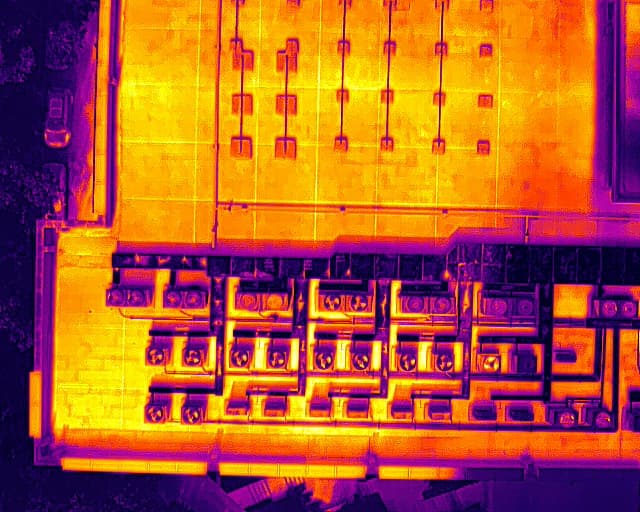
A thermal camera measures infrared radiation – it does not depend on visible light like our eyes. In darkness a live dog's temperature contrast with surroundings is sometimes easier to notice than in daytime, but a warm night or humidity can reduce the difference.
This is practical when you need to survey fields, parks, or forest edges – areas you cannot safely cover on foot at night in a short time.
- Area larger than you can safely cover on foot at night.
- Forest, tall grass, ditches – limited visibility on the ground.
- You do not know which direction the dog may be after several hours.
- Need to systematically survey an area and get coordinates for morning ground search.
Thermal imaging limits at night
A thermal camera does not see through solid obstacles – dense bushes, roofs, walls block the signal. It does not show an "animal photo" – only temperature differences that must be interpreted.
Every thermal finding still must be verified on the ground with a flashlight.
If you could not find them at night
Stop, rest, and continue at dawn. If you need a general action plan (posters, vets, registry), see the article "My dog is missing – what should I do?".
To share information with neighbours in the morning – prepare a poster with photo and phone number.